Summarize with
The window rattling in the garage or the dead central AC condenser behind the home is nothing more than clutter. It’s a piece of equipment governed by federal law, and getting rid of it wrong can cost you a fine you never saw coming.
Appliance removal services exist for a reason: most homeowners don’t realize that there’s still coolant in their old AC, sharp coil fins, and enough copper to interest a scrap buyer. The same considerations apply to oven and stove removal, especially when an old appliance needs to be picked up, recycled, or properly disposed of.
EPA’s Section 608 program states that all air conditioners must be recovered before they are scrapped, recycled, or sent to a landfill.
Unfortunately, J&S Hauling faces this issue more than once a week, and it is a matter of details, not just words.
This guide walks through how air conditioner removal services actually work, what the law requires, what recycling really recovers, and where the real cost differences show up between doing it yourself and calling appliance removal services that do this for a living.
How Air Conditioner Removal Works
Properly done appliance removal services consist of three different stages, and it’s when people fail to complete one or more of them that they run into trouble.
First, the refrigerant must be removed. Most pre-mid 2000s-manufactured central air units and window models employ R-22 refrigerant, which is no longer produced by the EPA due to its ozone-depleting properties.
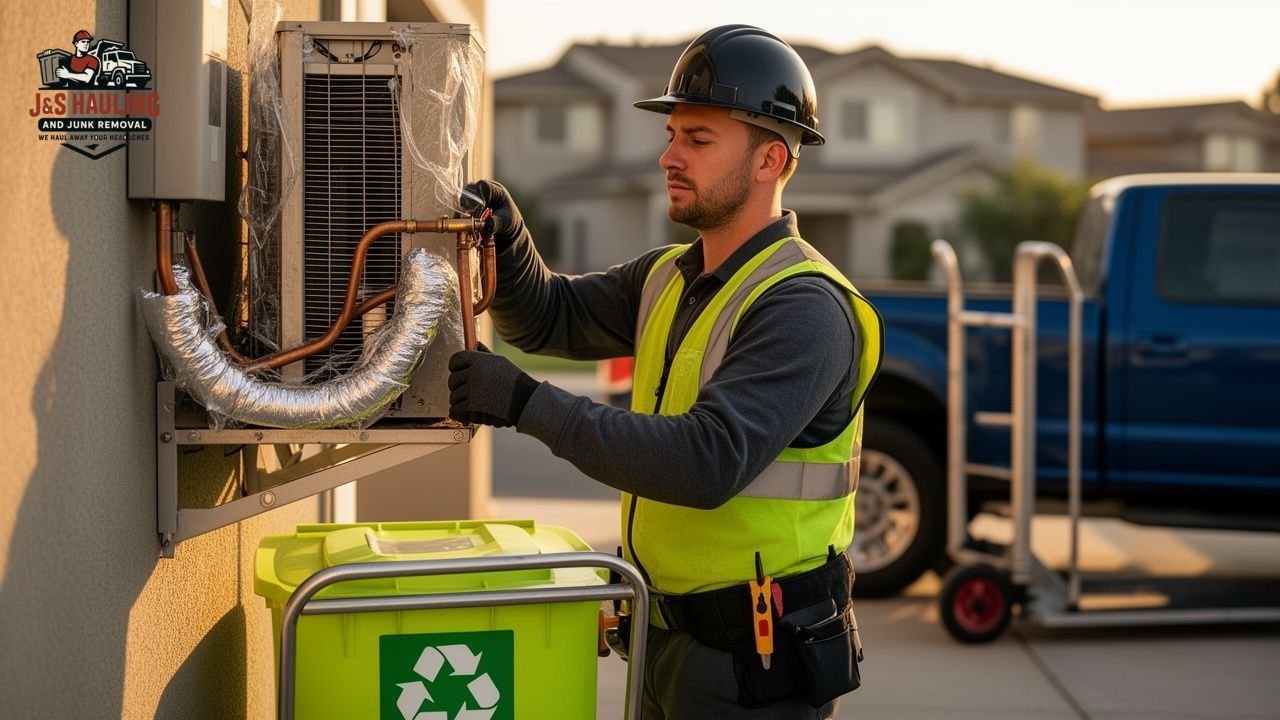
Newer systems are equipped with R-410A, which is not ozone-depleting but is still subject to the same Clean Air Act regulations. Either it’s illegal to vent it into the air, or the technician who is doing the recovery must be certified by EPA Section 608 in order to do so legally, whether this technician is doing the recovery on his own or as part of a larger appliance removal services company.
Central condensers can be as heavy as 100 to 200 pounds and sometimes are located on a concrete pad, making moving them to the outside with a dolly difficult without the proper setup, which is what experienced appliance removal services are well equipped to handle.
Third, the transport to the proper end point (a certified scrap recycler, a municipal hazardous waste facility, or a retailer take back program, depending on the type of unit and where the end point is located).
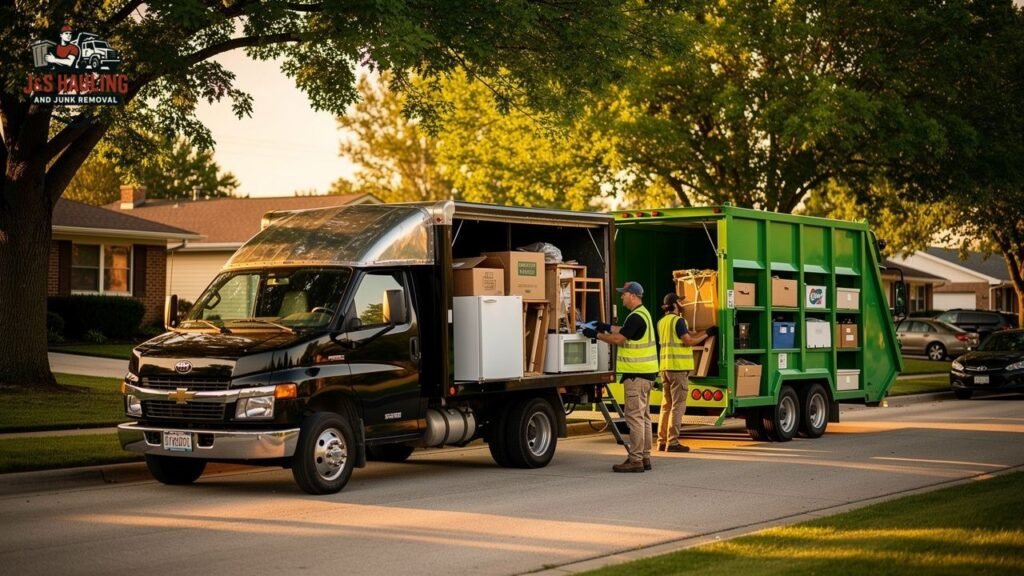
The three stages are all completed under one appointment with a reputable appliance removal service, which is the primary reason that people hire appliance removal services rather than carrying a 150 lb. condenser to the curb.
How to Prepare an AC Unit for Removal
There are several ways that homeowners can save some time on pickup day. By doing a few things before the crew arrives, homeowners can save some real time on pickup day. It’s not difficult, but it is easy to forget about, and it can have a direct impact on the speed of appliance removal services.
Refrigerant Recovery Comes First
If your AC unit still has a working compressor and hasn’t been serviced recently, assume it still has refrigerant in it.
A technician has to evacuate that refrigerant using certified recovery equipment before the unit can legally leave your property for scrap or disposal, per EPA disposal requirements for stationary refrigeration equipment.
Trying to skip this step, or assuming a unit is “empty” because it stopped cooling, is one of the most common and most expensive mistakes homeowners make before booking appliance removal services.
Draining, Disconnecting, and Staging for Pickup
For window units, drain any standing condensation and remove the unit from the window frame before pickup day, since crews from most appliance removal services typically aren’t authorized to do interior window work.
When booking appliance removal services, if your unit is on a rooftop or a second story balcony, please let us know, as this will affect the number of appliances and crew required. This is what makes a quick one-stop job a rescheduled job.
Where to Recycle Old AC Units
People often ask where to recycle old AC units, assuming it’s the same as recycling a cardboard box.
It isn’t. Most curbside recycling programs will not take an AC unit under any circumstances because of the refrigerant and the sealed compressor oil inside, which is one more reason appliance removal services exist as a separate category from regular trash pickup.
Municipal Recycling Centers and Scrap Yards
Fees typically run $25 to $75 per unit, and most municipal programs require proof that refrigerant has already been recovered before they’ll accept it, a document that professional appliance removal services provide automatically.
Scrap metal yards are another route. A typical residential condenser holds somewhere between 15 and 30 pounds of copper in its coils and wiring, which is the main reason scrapping pays out more than most people expect, generally in the $40 to $150 range depending on size and current copper prices.
Retailer Take Back and Utility Rebate Programs
Some big box retailers will remove your old window unit for a flat fee (often $25 to $50) when they deliver a new one, and several regional utility companies run seasonal rebate programs that pay $25 to $50 for retiring an old, inefficient central AC unit early.
These programs change year to year and by ZIP code, so it’s worth a quick call to your utility provider or to a local appliance removal services company that keeps track of current rebate windows before assuming your unit only has scrap value.
Recyclable Metals: What Can Be Recycled From an Old Unit
A fair question homeowners ask before scheduling pickup is whether can air conditioners be recycled at all, given how much of the unit is plastic housing and electrical components. The honest answer is yes, and the recoverable materials are more valuable than most people assume.
Beyond the copper in the coils, a residential unit typically contains 10 to 20 pounds of steel in the housing, plus aluminum fins that, while lower value per pound than copper, still add up.
Commercial rooftop units contain far more, sometimes 80 pounds or more of copper alone, which is why demolition contractors rarely throw HVAC equipment in a standard dumpster and instead call in appliance removal services that separate materials by grade before recycling.
The plastic shrouding and non-metal components generally go to standard waste streams after the metal and refrigerant are separated, since there isn’t currently a widespread recycling stream for the mixed plastics used in AC housings.
That’s a real limitation worth knowing about rather than a reason to skip proper AC disposal services altogether.
How Much Does Air Conditioner Removal Cost
The most often asked question relates to the cost of the air conditioner removal: “How much does air conditioner removal cost? This will depend significantly on the type of unit, location, and even whether any record exists showing the refrigerant has been recovered.
| Removal Method | Typical Cost | What’s Included |
|---|---|---|
| DIY drop off (refrigerant pre-recovered) | $25 to $75 | Municipal facility fee only |
| Scrap yard drop off | $0; may pay you $15 to $50 | Requires proof of recovery |
| The retailer takes back | $25 to $50 | Often bundled with new unit delivery |
| Professional appliance removal services | $75 to $250 | Recovery, disassembly, transport, disposal |
| Large commercial or rooftop unit removal | $200 to $600+ | Crane or lift access, multi-person crew |
When considering all the elements of refrigerant recovery, labor, and transport, most homeowners can expect to pay in the range of $100 to $250 for the removal service for a window or central unit.
That price climbs for units in hard to reach spots, like second floor windows or rooftop commercial systems, because the labor and equipment needed go up along with the risk, which is reflected in what most appliance removal services quote for those jobs.
Professional AC Removal vs. DIY Disposal
This is where the real decision gets made, and it’s rarely just about price.
Professional AC removal vs DIY disposal comes down to three things: legal exposure, physical risk, and time.
Doing it yourself might save $50 to $100 on paper, but if the refrigerant hasn’t been properly recovered by a certified technician, you’re looking at potential Clean Air Act violations that carry fines up to $44,539 per day per violation, according to EPA enforcement guidance, not a risk most homeowners are willing to take on for the sake of a weekend project.
There’s also the physical side. Central condensers are heavy, awkwardly shaped, and often positioned somewhere that makes a solo lift dangerous, particularly on uneven concrete pads or gravel.
Where DIY genuinely makes sense is with a small, already empty window unit that’s light enough to carry to a municipal drop off point without help. Beyond that, hiring appliance removal services isn’t really about convenience so much as it is about avoiding a fine or a trip to the ER for a back injury.
Most homeowners who try DIY disposal once, on a heavier central unit, end up calling appliance removal services for the next one anyway.
How to Dispose of an Old Air Conditioner the Right Way
The first step in knowing how to dispose of an old air conditioner is to make sure that it has refrigerant in it, and then selecting the disposal route that is appropriate for your type and local regulations. This is an important part of old appliance disposal, especially when the appliance contains refrigerant.
Contact your municipal solid waste department first, as some municipalities have special times or days for appliance recycling, or you could find it is cheaper to collect appliances than it is to go to a scrap yard.
Even if the unit is still operating, it’s worth determining if there’s a utility rebate program before it’s simply time for the scrapping.
If the unit still runs, check whether a utility rebate program applies before assuming it’s only worth scrapping.
If no one is quite sure which route to follow, there are professional AC disposal services available through established appliance removal services that generally cover the whole process, from documenting the refrigerant recovery and all the way to taking the AC to a certified disposal facility for recycling, eliminating the need for homeowners to do research on their own regarding local regulations.
Common Mistakes to Avoid
Some of the patterns re-emerge in AC disposal, and most of these can be prevented with a bit of planning.
Setting a unit at the curb on trash day without confirming it’s accepted is probably the most common one; most municipal sanitation crews will leave it sitting there, sometimes for weeks, because standard trash pickup doesn’t cover refrigerant containing appliances.
Assuming a non functioning unit has no refrigerant left in it is another frequent mistake, since a failed compressor doesn’t necessarily mean an empty system.
Trying to remove copper coils before refrigerant recovery is both illegal and dangerous, since cutting into a pressurized line can cause frostbite injuries or release refrigerant that’s harmful to inhale. And skipping documentation matters more than people think.
If a scrap yard or recycling center asks for proof that refrigerant was recovered and you don’t have it, they’re legally required to turn the unit away, which is exactly the paperwork gap that experienced appliance removal services are trained to close.
FAQs
How long does an AC removal appointment usually take?
A single window unit typically takes under 30 minutes once a crew is on site. Central systems with refrigerant recovery involved usually run 45 minutes to an hour and a half, depending on accessibility.
Is a pickup required?
The vast majority of companies will have someone on-site to sign off on the completed removal, with some letting scheduled drop-offs for multi-unit blocks such as apartment complexes.
What happens to the refrigerant after it’s been recovered?
Recycled refrigerant is used in existing equipment or returned to a certified reclaimer to be purified to meet industry purity standards (which are directly controlled by EPA Section 608) for resale
Can I get a rebate for replacing a used unit rather than just a rebate if I’m discarding it?
Sometimes. Several regional utilities run seasonal early retirement rebate programs for inefficient central air systems, generally in the $25 to $50 range, though availability changes by provider and by year.
Getting It Done Right
An old AC unit sitting in a garage or bolted into a window frame isn’t just an eyesore. It’s regulated equipment, and handling it wrong carries real legal and physical risk that most homeowners would rather avoid.
Whether you’re dealing with a single window unit or a full central system pulled during a renovation.
J&S Hauling and Junk Removal handles refrigerant documentation, disassembly, and certified disposal in one appointment, offering the kind of reliable appliance removal services homeowners can book once and not think about again.
Phone: (618) 310-6823 Email: jasen@jshauling.com
Sources
EPA, Stationary Refrigeration Safe Disposal Requirements.
Describes the federal regulations (40 CFR Part 82 Subpart F) for reclaiming refrigerant before disposal of air conditioning and refrigeration equipment.
EPA, Recovering, Recycling, and Reclaiming of Refrigerants.
Describes the difference between refrigerant recovery, recycling, and reclamation and the purity standards that must be met before reuse.
EPA, Regulatory Updates: Section 608 Refrigerant Management Regulations.
Explain the certification procedures for a technician and the consequences of not following proper handling or disposal procedures with refrigerants.
EPA, Section 608 of the Clean Air Act Overview.
Describes the National Recycling and Emission Reduction Program (NRERP) and how it helps reduce ozone-depleting and greenhouse gas (GHG) refrigerant releases.