Summarize with
A top-loading washer runs 150 to 250 pounds, and a fair share of that is a concrete counterweight bolted next to the drum. Which is why the old machine usually just stays where it died. It quits, the new one arrives, and the dead unit sits in the basement for another eight months because nobody wants to find out what happens halfway up the stairs. Professional appliance removal services exist for exactly that stalemate.
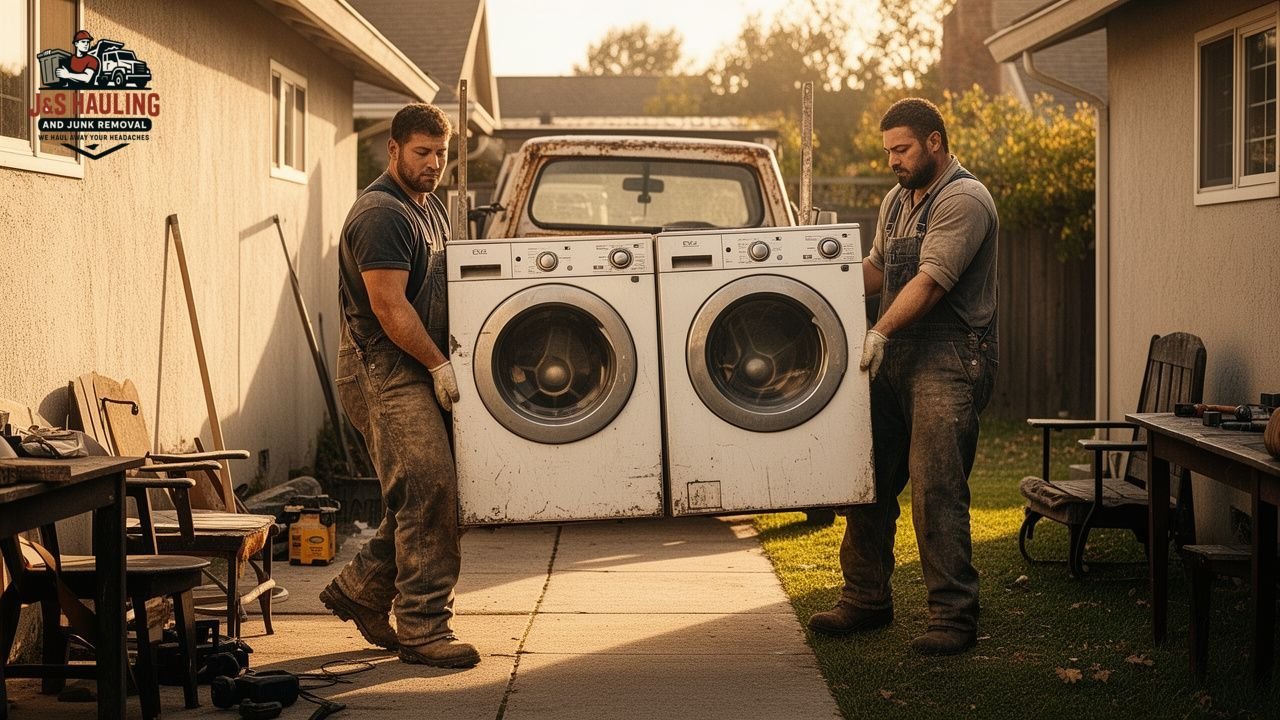
A crew from J&S Hauling lifts it, hauls it, and gets it to a recycler instead of a hole in the ground. The U.S. Environmental Protection Agency warns that appliances left at the curb often end up landfilled or handled unsafely, and avoiding that is most of what good appliance removal services actually do. Below: pickup, disposal, recycling, and what any of it costs in 2026.
Why Washer and Dryer Removal Matters
Heavy things fill landfills fast. The EPA counted 19.2 million tons of ferrous metals in municipal solid waste in 2018, roughly 6.6 percent of everything Americans threw out that year. Major appliances made up 3.1 million tons of what got recycled, putting them in the top ten most recycled products nationally. Landfills still swallowed 10.5 million tons of steel.
So every set that reaches a recycler instead of a pit keeps dense metal in circulation. Proper Washer and Dryer Removal also keeps the unpleasant bits out of the soil: capacitors, small amounts of oil, the occasional control board. There is a selfish argument too, and it is probably the more persuasive one.
Hire a licensed hauler and you are not the person who drops 200 pounds on their own foot, or the person who gets a dumping citation because the city tracked a serial number back to their address. That is the practical reason most people call appliance removal services at all.
How Washer and Dryer Removal Works
Most people picture two guys and a truck. There is a bit more structure behind appliance removal services than that, and understanding how washer and dryer removal works will save you money on the quote itself.
It starts at booking, where the details matter more than anyone expects. One unit or a pair. Stacked or side by side. First floor or basement. That is what sets the number. The crew arrives with dollies and straps, puts down floor protection, confirms the machines are actually disconnected, and walks them out along whatever route is least likely to gouge a doorframe. Tight stairwells slow everything down, so mention them when you book and the quote stays honest.
After that the machines go on the truck and head to a sorting facility, a scrap processor, or a recycling partner. Reputable washer and dryer removal services can tell you which one, whereas a trip to the transfer station ends the story at the gate. J&S Hauling treats that last leg as the actual job.
How to Prepare Appliances for Pickup
Ten minutes of prep can shave real money off the bill, and knowing how to prepare appliances for pickup keeps your baseboards intact on the way out.
Kill the power first. Unplug the washer, and if the dryer is hardwired to a 240-volt circuit, flip the breaker rather than yanking anything. Then close the hot and cold valves behind the washer, unscrew the supply hoses, and drain whatever is still sitting in the drum and the pump filter.
Skip that and you will learn how much water a washer holds the moment it tips onto a dolly. Gas dryers are their own category. Close the shutoff valve, and if you have any doubt at all, pay a licensed plumber to cap the line. Most appliance removal services will not touch a gas connection they did not disconnect themselves, so that one is on you.
Then clear a path. Rugs, laundry baskets, the shoe rack by the side door. Measure your doorway if you can, since a 27-inch washer and a 28-inch opening is a five minute door removal instead of a phone call about rescheduling. Minor stuff, all of it, but it turns an awkward hour into a fifteen minute pickup.
Can Old Appliances Be Recycled?
Almost entirely, which surprises people. The short answer to can old appliances be recycled is that very little of a washer or dryer actually becomes waste. Steel accounts for roughly 75 to 90 percent of a large appliance by weight, and one washing machine holds 50 to 80 pounds of it. Add the copper windings in the motor and the aluminum in the smaller components and you have a machine scrap buyers genuinely want.
EPA figures put the recycling rate for all materials in appliances, ferrous metals included, at 59.8 percent. The full ferrous metals data on the EPA site has the year by year breakdown if you want the raw tables. Recycled steel also takes far less energy than smelting ore, which is the part usually lost in the feel-good version of this conversation. One washer changes nothing. A few million a year changes the math on domestic steel supply.
Where to Recycle Washers and Dryers
Deciding where to recycle washers and dryers really comes down to how much of the labor you want to do yourself.
Scrap yards will usually take a washer or dryer for free, sometimes paying a few dollars for the metal, but you are supplying the truck and the back. Municipal bulk pickup exists in most towns, though schedules run slow and the rules shift block to block. Retailers like Lowe’s and Home Depot will haul the old set when they deliver the new one, free with some purchases and $30 to $50 per unit without. EPA national recycling data already lists appliances among the most recovered products in the waste stream, so any of these routes beats the curb.
The fourth option is a full-service hauler. A dedicated appliance removal company comes to the house, brings the unit up from the basement, and delivers it to a recycler on your behalf. You pay for that, obviously. It is also why most homeowners end up calling appliance removal services instead of talking a friend into lending a pickup on a Saturday.
What Happens After Appliance Removal
People ask what happens after appliance removal more often than you would guess, and it is a fair question, since the entire value of the service happens off your property. It is also the part appliance removal services are least likely to explain unless someone asks.
Units get inspected and sorted at the yard. Anything still working and reasonably modern may be cleaned up and resold. Everything else goes to a processor.
There the machine gets torn down. Magnets pull the steel frame and drum, copper wiring is stripped and bundled, aluminum and plastic move to their own streams. Oil and any hazardous components are handled under environmental rules rather than shredded in with the scrap.
The clean steel gets baled and sold to mills that melt it back into new product. The washer your crew carried out in twelve minutes can be rebar inside of a month.
Cost of Washer and Dryer Removal
The cost of washer and dryer removal in 2026 depends on access, quantity, and who you hire. The ranges hold pretty steady nationally.
A single unit through a full-service crew runs $75 to $180. A washer and dryer pair usually lands between $145 and $300, with most jobs settling near $200. Angi puts the national average for appliance removal around $100, commonly $60 to $180 per item.
What pushes you up that range: stairs, stacked units, gas disconnection, a second-floor laundry room. What pulls you down: a disconnected pair already waiting in the garage. If you are buying new, retailer haul-away is the cheapest path going, often free with the purchase or $30 to $50 per appliance without one.
Working out how to dispose of an old washer and dryer is mostly choosing what you would rather spend: money or a Saturday. Retailer pickup wins on price, provided you are buying something. Appliance removal services win when you are not.
Bundling is the one real lever you have. A washer nowhere near fills a truck, so a second item usually costs a fraction of a separate trip. When you compare quotes, ask what is actually included: labor, stairs, disposal fees. Those are the three that tend to resurface at the end.
Choosing the Right Appliance Removal Company
Price is a poor way to pick a hauler, though it is how nearly everyone does it. Start with licensing and insurance when you weigh one appliance removal company against another. Someone is carrying 200 pounds down your staircase. If that goes badly, you want it covered, and so do your drywall and your banister.
Then ask where the units actually go. A company that can name its recycling partner and walks you through the chain is probably telling the truth about it. Vague answers usually mean the transfer station. After that: recent reviews, a written quote covering stairs and disconnection, and a pickup window that fits your week rather than theirs.
J&S Hauling runs on flat upfront quotes and a recycling-first disposal path, and honest appliance removal services should explain that chain before you book rather than after. Call us at (618) 310-6823 and the old set can be out of the basement this week.
Does J&S Hauling offer washer and dryer removal in my area?
Probably, though one call settles it. The core service radius covers most surrounding neighborhoods, and if your address falls on an existing route, pickup is typically a day or two out. Same-day slots open more often than people expect for closer zip codes.
How fast can a crew reach my city for pickup?
Inside the main service area, same-day or next-day is normal. Outlying towns occasionally wait an extra day so nearby stops can be grouped, which is also what keeps the price down for everyone on that run.
Do local recycling rules affect my washer and dryer removal?
Yes. Some cities set specific handling requirements for appliance components, and a local appliance removal company already knows them without having to look anything up. That is one of the quieter arguments for hiring nearby.
Is weekend appliance removal available near me?
Usually, but weekends book first. Three or four days of notice gives you actual choice of time slots, especially in spring and summer when half the neighborhood seems to be moving.
How long does a washer and dryer removal take?
Ten to twenty minutes for a straightforward first-floor pickup. Basement carries, stacked pairs, and narrow staircases stretch that out, which is precisely why the booking details matter.
Do I need to disconnect the appliances myself?
For electric units, yes. Unplug them and drain the water. Gas dryers need a licensed professional to disconnect and cap the line first, because most appliance removal services are not permitted to do gas work for you.
Will you take a washer or dryer that no longer works?
Yes, and broken units are arguably the better recycling candidates. A dead washer holds the same steel, copper, and aluminum as a working one. Whether the drum still spins makes no difference to a magnet.
Is it cheaper to scrap the appliance myself?
If you own a truck and live near a scrap yard, yes. Sometimes the metal even covers the gate fee. Most people do not own the truck, and that is really the entire calculation behind the cost of washer and dryer removal: you are paying someone else to own the truck, the dollies, and the sore back.
Sources